

Re-embedding the Social: New Modes of Production, Critical Consumption and Alternative Lifestyles

SASE 2016 Mini Conference: https://sase.org/2016—berkeley/mini-conferences_fr_232.html

Location: Berkeley, University of California

Date: June 24-26, 2016

Mini-conference organisers: Francesca Forno, Paolo R. Graziano, Lara Monticelli, and Torsten Geelan

Extended abstract: approx. 1000 words to be submitted through the SASE website, clearly stating that you wish to be considered for this mini-conference https://sase.org

Expected output: edited collection or special issue

Extra-conference activity: visiting/dining at local co-operative/eco-village (tbc) Any questions: email miniconf13.sase@gmail.com

Call for papers:

The recent and yet unresolved Great Recession has revealed all the limitations and flaws of the ‘economic moralities’ embedded in neoliberalism which have been guiding the functioning of economic and political institutions in numerous countries. Within this context, the idea that we are moving towards a post-capitalist society, characterized by new norms and values, has come to the forefront of academic and public debate. In tandem with the rise of social movements (e.g. Occupy Wall Street, Indignados, Gezi Park) and the success of radical political parties (e.g. Podemos and Syriza), every day economic practices of production, organization and consumption are also being questioned and challenged by a growing number of ‘critical’ citizens, families, communities and entrepreneurs. These attempts often take the form of local, horizontal and collaborative initiatives such as consumer-producer networks, cooperatives, ethical banking, co-working spaces, time banks, eco-villages, transitional communities, guerrilla gardening and social-community street art.

All these practices share a steadfast belief in the idea of ‘social sustainability’, and a desire to move towards a society which – in the words of Amartya Sen – promotes not just environmentalism but also values of equality, diversity, social cohesion, quality of life and democratic governance of our workplaces and every-day lives. While this silent wave may appear less disruptive in nature than traditional forms of political contention (e.g. protests, strikes, and riots), such economic practices and ideas have the potential to gradually disrupt the economic moralities underlying many capitalist modes of production and the ways in which we consume goods and services. The engine of this slow, but long lasting transformation can be found in a tripartite movement: critique of the status quo, practices of resistance and resilience and, finally, exploration of alternatives through deliberative and collective decisional processes.

This Mini Conference welcomes theoretical and empirical contributions from around the world and across the social sciences (sociology, political science, development studies, economics, anthropology, business, and philosophy) that touch on the following three themes:

1) New Modes of Production

The social economy refers to economic activity that is directly organized and controlled through the exercise of some form of social power – rooted in the voluntary association of people in civil society, and based on the capacity to organize people for collective action of various sorts. Nestled between the private sector (business) and the public sector (Government), this includes worker-owned cooperatives, social enterprises, charities, and non-profit organisations.

The range of economic activities that can be organized through the social economy is very broad and includes recycling, childcare, housing, healthcare, disaster relief and web applications. The vibrancy and effectivness of which can be enhanced through institutional design, such as state subsidies, social economy investment funds (e.g. crowdfunding), governance through associational democracy, and participatory democratic forms of organisation. One of the most illustrative examples of the collaborative productivity that can be achieved through this way of organizing economic activity is Wikipedia – the only non-corporate website among the worlds’ top 10 most visited web addresses – whose fundamental principles of organisation are: non- market relations (voluntary, unpaid contributions and free access); egalitarian participation; deliberative interactions among contributors, and democratic governance.

This panel seeks to move scholarship forward in this area of research by welcoming contributions that:

  • Critique existing modes of production in the social economy;
  • Provide empirical examples and theoretical accounts of how the social economy could be further enhanced through institutional design;
  • Identify and explore cases of organizing economic activity through the social economy in hiterto unexamined countries, economic sectors, and geographical levels (local, regional, national, supranational).

2) Critical Consumption

Over the past years, new social movements (Sustainable Community Movement Organizations) have emerged, going beyond more traditional forms of mobilization and of contentious politics. SCMOs are focused on exploiting alternative forms of consumption as a political tool: organizations and movements such as community food networks, community sustained agriculture and fair trade, are all examples of SCMOs which have gained increasing relevance globally. The crisis has provided further space for such organizations which have helped – and are still helping – to build new social relationships and resistance in a context of radical revision of the function of the market.

The growth in the number of ‘political consumers’ has generated considerable scholarly interest. Many of the studies on the topic, however, have analyzed this phenomenon mainly from the individual consumer perspective while less attention has been paid to the role of social movements promoting collective political actions. Such limited attention is quite surprising since an increasingly number of movement organizations acting both at the global and at the local level have started to incorporate political consumerism into their repertoire of actions, asking citizens to make use of their ‘shopping bag power’ to achieve greater environmental and social justice.

This strand welcomes contributions discussing theoretical challenges posed by SCMOs and/or empirical illustrations in both the Global North and the Global South. We are particularly interested in papers that investigate:

  • Why, how and whether Sustainable Community Movement Organizations emerge and succeed in triggering sustained political engagement;
  • To what extent and how are SCMOs linked to specific movements such as the global justice movement and the indignados movement etc.;
  • Where, and in what form, are grassroots economic initiative emerging and engaging the public;
  • How can developments in political consumerism, and critiques thereof, inform the development of social movement research and vice versa;
  • What is the effectiveness of such organizations in local, national and international political contexts.

3) Alternative Lifestyles

In this panel, we aim at discussing theoretical and empirical (academic and/or activist based) research on all those, increasingly diffused, everyday practices that are based not (or not only) on monetary transactions but on trust, interchange and reciprocity. Examples range from daily ‘sharing economy’ practices – such as car sharing, couch-surfing, house swapping, co-working – to more radical and explicitly anti-capitalistic ones – like eco-villages or intentional communities – whose members’ aim is to literally ‘escape’ from a lifestyle characterized by a never ending cycle of work-production-consumption. The decision to be involved in such practices – as individual citizens or whole communities – entails a profound critique of contemporary lifestyles and introduces new customs.

We welcome papers that address:

  • The extent to which these practices constitute (or not) ‘coping mechanisms’ for socio- economic exclusion;
  • The way through which these practices manage to provide not just material goods but services outside a ‘market’ logic;
  • The way in which citizens, public institutions, political parties and private businesses perceive and interact with these practices;
  • The extent to which these practices succeed (or fail) in introducing societal values and norms (reciprocity, exchange, mutual help) that are an alternative to neoliberal ideology, and help foster a ‘new imaginary’ for progressive social change.

Dansk Sociologkongres – Det er nu!

Dansk Sociologkongres løber af stablen d. 28-29. januar 2016 i Aalborg, og det er NU man skal tilmelde sig, hvis man gerne vil have chancen for:

  • At deltage i en spændende kongres med meget aktuelt tema: ”Krise, Konflikt og Kritik”
  • At høre de tre internationalt anerkendte keynote speakers:
    • Professor Hans Joas, Humboldt-Universität, Berlin
    • Assistant Professor Catherine Corrigall-Brown, Department of Sociology, University of British Columbia Vancouver, Canada
    • Professor Arne Johan Vetlesen, Universitet i Oslo
  • At deltage i kongressens mange forskellige sessioner
  • At være med til at holde det danske sociologfaglige miljø levende, både fagligt og socialt

Vi har rykket deadline for tilmelding til d. 17/12-15, og håber at du vil melde dig til.

Samtidig vil vi gerne bede dig om at sprede kendskabet til kongressen og opfordre dine kollegaer til at deltage.

Information om kongressens indhold, sessioner og tilmelding findes på: www.sociologkongres.aau.dk


Mange hilsner fra Arrangørgruppen

Call for Papers for the 9th International Conference on Social Science Methodology (ISA RC33) at the University of Leicester (United Kingdom)

Conference Date: September 11th – 16th, 2016

Submission Deadline for Papers: 21st January, 2016

Session Topics
There will be sessions on a broad range of methodological topics ranging from the following topics:
1. Survey Methodology and other QUAN Approaches
2. QUAL Methods
3. Mixed Methods
4. New Data Types
5. Methods for Longitudinal and Comparative Research
6. Paradata, Metadata, Meta-Analysis and Harmonization
7. Methods for Substantial Research Fields

Please check the Conference Website for a full list of sessions and session descriptions.
Conference Website
http://www2.le.ac.uk/departments/sociology/research/rc33-conference/rc33-conference

Please find further information on ISA RC33 (Research Committee on Logic & Methodology of the International Sociology Association) on http://www.rc33.org/

How to Submit an Abstract
1. To submit a paper abstract for any session of the RC33 9th International Conference on Social Science Methodology, you should visit:
http://www2.le.ac.uk/departments/sociology/research/rc33-conference/rc33-conference.
After landing on the homepage, navigate to ‘Abstract Submission’, which appears in the top left hand column of the webpage.
2. Complete the form in full. You may wish to cut and paste your abstract into the Abstract field from another document.
3. Choose the relevant session for your stream. To do so you will need to select the relevant lead session organiser from the drop-down menu highlighted in the image below. To check you are submitting to the correct session, you can view a table of sessions and session convenors by clicking the link entitled ‘View the list of sessions and session convenors’. Once complete, click submit.

CALL FOR ABSTRACTS – The 28th Conference of the Nordic Sociological Association, 11-13 August, 2016, Helsinki, Finland

The Organizing Committee cordially invites you to submit an abstract for a paper to be presented at the next conference of the Nordic Sociological Association by 16 February, 2016.

When we planned this conference, we wanted to organize an event that would address the place of sociology in a world where new threats awake old divides and where increasing social, political and economic instabilities are affecting all regions, including the Nordic countries. When this call is becoming finalized, thousands of refugees, many of them fleeing the brutal conflict in Syria, have already for some months been streaming across Europe in search of safety and security. The terror attacks around the world flood the news with stories of human suffering. These events give rise to compassion, but they also boost turmoil and distrust, making the threat of deepening divides between the Global North and Global South, the East and the West, increasingly acute. Such divides do not remain at the level of regions, however. Rather, new divisions are emerging within societies. These troubled times call for engaged but critical sociologies, developed to examine the complex problems of our times in a reflexive way. It is also important not to let these ‘meta-events’ overshadow other, deep-rooted cleavages that sociology may have neglected, if we wish to develop a sociology beyond its ‘black spots’.

The theme of the conference is ‘Knowledge-Making Practices and Sociology’s Global Challenge’. The theme calls us to think together about ways to address the Eurocentrism and parochialism of many of our central concepts and categories. In addition to the conference’s theme, the programme covers other themes of general interest, such as North-South issues within the Nordic region, the renewed political tensions between East and West in Europe, sociology’s relation to economics, and where and how sociologists publish their research. We invite abstracts in all major sociological areas. In addition, we welcome contributions related to the conference’s theme as well as other current themes in sociology.

Read more about the conference on the conference website nsa2016.org

On our website you will also find the instructions for submitting an abstract. Abstracts are to be submitted using the electronic form on the website, nsa2016.org/call-for-abstracts/

Important dates

11 January 2016 Registration opens

16 February 2016 Deadline for abstracts

5 April 2016 Notification for accepted abstracts

5 May 2016 Early bird registration deadline

5 June 2016 Registration deadline for paper presenters

Velkommen til den nye hjemmeside!

2015 blev året hvor Dansk Sociologiforening ikke blot skiftede navn, vedtægter, strategi og logo men også HJEMMESIDE! Velkommen på den nye side, hvor I kan finde al relevant information om foreningens aktiviteter, historie og ikke mindst – hvordan I melder jer ind og tilmelder jer vores nyhedsbrev 😉 Den nye side afspejler, at Dansk Sociologiforening i dag er en foreningen for alle, der arbejder eller beskæftiger sig med sociologi i Danmark uanset baggrund. Vi satser fremover på aktiviteter, der rækker bredt ud, så det sociologiske perspektiv bidrager til debatten ikke blot i forskningsverdenen men også uden for universitetets mure. Vel mødt til seminarer, debataftener og foredrag, der sætter tidens udfordringer til debat!


Bedste hilsner,

Anna Ilsøe,

Formand for Dansk Sociologiforening

KAMPEN OM DISCIPLINERNE – KAN ANTROPOLOGER OG SOCIOLOGER PÅVIRKE POLITIKKEN?

Stadig flere sociologer og antropologer sidder i dag i stillinger, hvor de arbejder med politikudvikling af forskellig slags – i ministerier, internationale organisationer, NGOer og interesseorganisationer. Denne udvikling peger på en masse muligheder, men også en masse udfordringer for vores faglighed.
I hvor høj grad kan vi tage vores faglighed med ind i politikudviklingen, når vi arbejder side om side med økonomer, jurister og statskundskabere?
Er det muligt at bidrage med et sociologisk eller antropologisk perspektiv på problemstillinger såsom menneskerettigheder, klimaforandringer, arbejdsmarkeds- eller udenrigspolitik – eller kommer vores fagligheder til kort i mødet med de klassiske DJØF-discipliner?
Kan et antropologisk eller sociologisk menneske- og samfundssyn forenes med de krav, der bliver stillet i forskellige former for policy making?

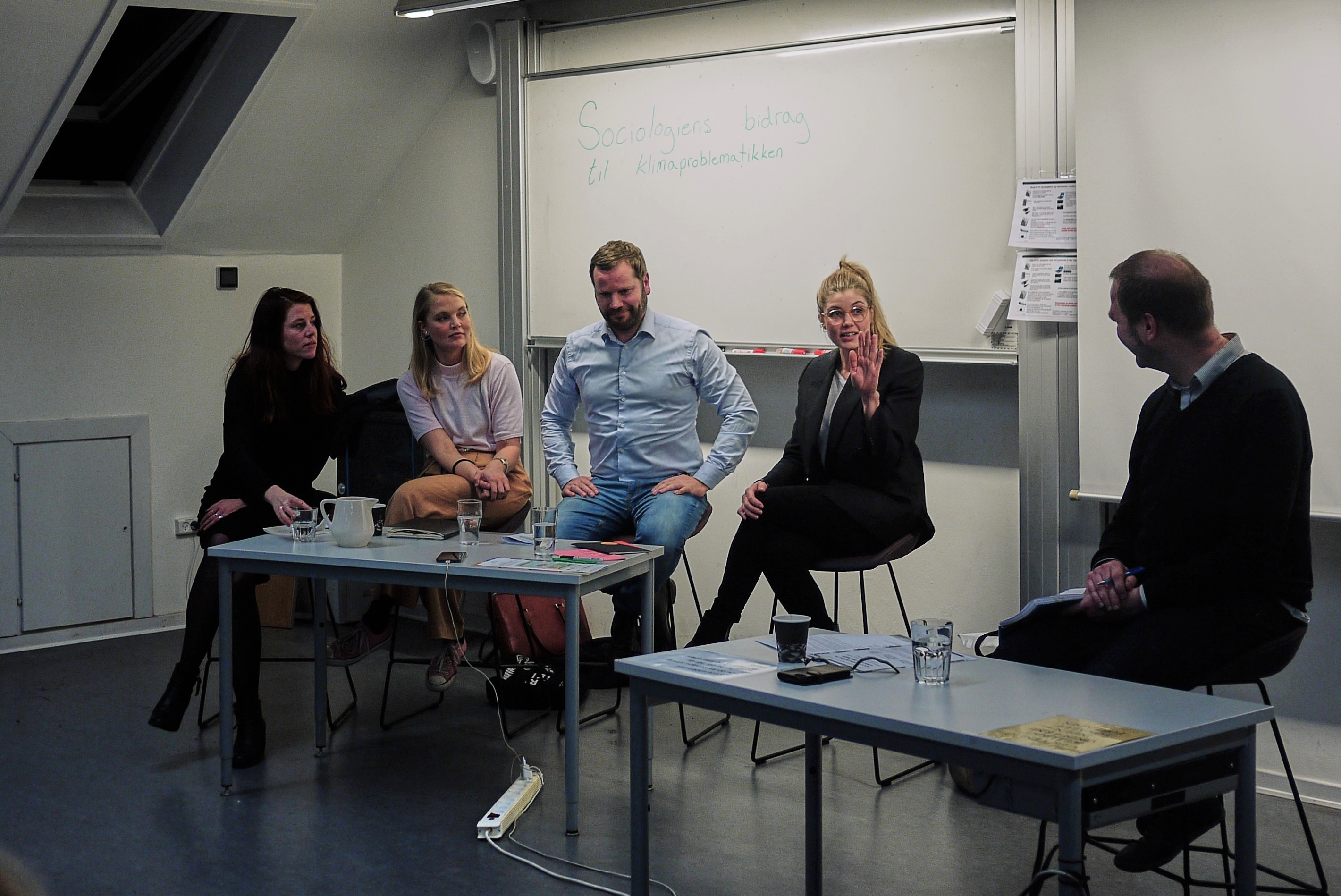
Disse spørgsmål og en masse andre vil vi tage fat på, når vi den 25. november diskuterer vores fagligheders rolle, muligheder og udfordringer i det politikudviklende arbejde sammen med 4 antropologer og sociologer, der til daglig arbejder med politik på forskellig vis.

Til at åbne debatten har vi fået Finn Collin og David Budtz Pedersen, der begge er medforfattere til bogen “Kampen om disciplinerne” til at komme og give deres analyse af, hvilken rolle de forskellige fagligheder, særligt de humanistiske og de såkaldt “bløde” samfundsfaglige discipliner spiller i samfundet i dag.
Efterfølgende vil der være debat med forfatterne og de fire paneldeltagere:
– Birgitte Feiring, antropolog, Institut for Menneskerettigheder
– Darriann Riber, antropolog, Udenrigsministeriet
– Sarah Steinitz, sociolog, Arbejderbevægelsens Erhvervsråd
– Marc Schade-Poulsen, antropolog, EuroMed Rights

Vi vil servere snacks og sodavand, og det vil være muligt at forsyne sig med et glas vin eller en øl til en bilig pris.

Vi glæder os meget til at se jer

Onsdag d. 25. november kl. 17.15-19 i Etnografisk Eksploratorium (CSS. 4.1.12).

De bedste hilsner,

Redaktionen,

Call for papers Dansk Sociologkongres 2016

Aalborg Universitet, 28. og 29. januar 2016

Kongressen sætter fokus på krise, konflikt og kritik, men vi vil gerne indbyde til oplæg i forhold til alle sociologiske emner.

Vi opfordrer alle, der gerne vil præsentere et paper på sociologkongressen til at indsende et abstract senest d. 1. december 2015. Sessionerne på kongressen opdateres løbende og fremgår af hjemmesiden:

http://www.sociologkongres.aau.dk/sessioner/

Abstracts bør være på 5-15 linjer og kan indsendes til sociologkongres@socsci.aau.dk eller til den ansvarlige for den pågældende session

Det er stadig muligt at komme med forslag til sessioner. Forslag kan sendes til følgende mailadresse: sociologkongres@socsci.aau.dk.

Bemærk at den seneste tilmelding til kongressen er den 10. december 2015.

DANSK SOCIOLOGKONGRES 2016 – CALL FOR PAPERS

Call for papers Dansk Sociologkongres 2016

Aalborg Universitet, 28. og 29. januar 2016

Kongressen sætter fokus på krise, konflikt og kritik, men vi vil gerne indbyde til oplæg i forhold til alle sociologiske emner. 

Vi opfordrer alle, der gerne vil præsentere et paper på sociologkongressen til at indsende et abstract senest d. 1. december 2015. Sessionerne på kongressen opdateres løbende og fremgår af hjemmesiden: 

www.sociologkongres.aau.dk/sessioner/

Abstracts bør være på 5-15 linjer og kan indsendes til sociologkongres@socsci.aau.dk eller til den ansvarlige for den pågældende session.

Det er stadig muligt at komme med forslag til sessioner. Forslag kan sendes til følgende mailadresse: sociologkongres@socsci.aau.dk.

Bemærk at den seneste tilmelding til kongressen er den 10. december 2015.

CALL FOR WORKING GROUP PROPOSALS

CALL FOR WORKING GROUP PROPOSALS – The 28th Conference of the Nordic Sociological Association, 11-13 August, 2016, Helsinki, Finland

The Organizing Committee cordially invites you to submit a proposal for organizing a working group at the next conference of the Nordic Sociological Association by 15th of November, 2015.

The Nordic Sociological Association does not have a formalized set of Research Networks. This means that organizing sessions in our conferences is up to the individual scholars and loose networks – meaning, your activity and voluntary work!

The theme of the conference is ‘Knowledge-Making Practices and Sociology’s Global Challenge’. The theme calls us to think together about ways to address the Eurocentrism and parochialism of many of our central concepts and categories. In addition to the conference’s theme, the programme covers other themes of general interest, such as North-South issues within the Nordic region, the renewed political tensions between East and West in Europe, sociology’s relation to economics, and where and how sociologists publish their research. We invite working group proposals in all major sociological areas. In addition, we welcome contributions related to the conference’s theme as well as other current themes in sociology. Please consider putting together a panel so that your research interests are reflected in the program!

Read more about the conference on the conference website www.nsa2016.org

On our website you will also find the instructions for submitting a workshop proposal. The proposal is to be submitted using the electronic form on the website,  http://nsa2016.org/call-for-working-group-proposals/

Deadline for workshop proposals is 15th of November, 2015.

Important dates

15 November 2015 Deadline work working group proposals

30 November 2015 Decisions on the working groups

10 December 2015 Call for abstracts published